
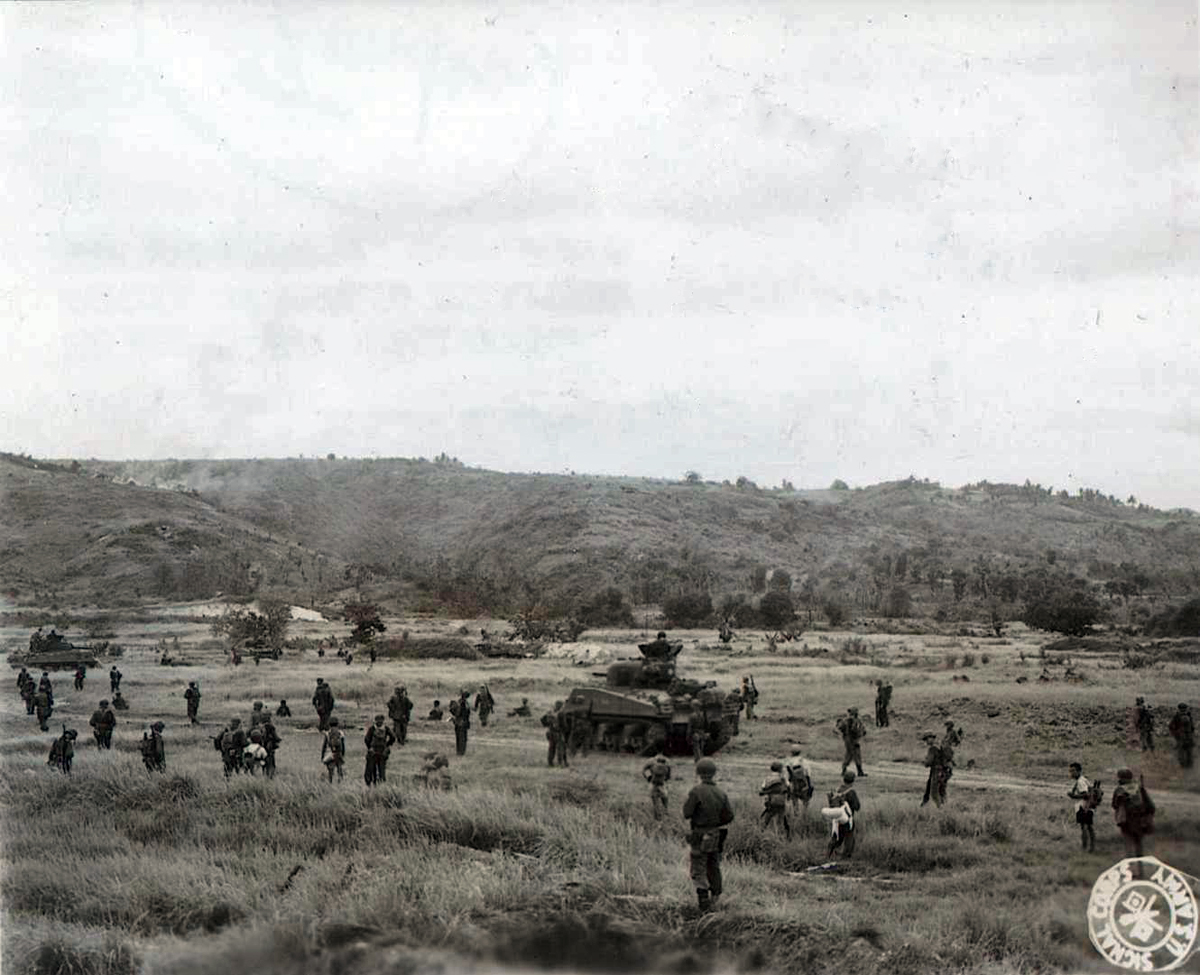
The horizon stretched on with the mountains of Cebu in the distance, not too near, yet not too far from the troops of the Americal division that were present inside the main body of Cebu City that had been captured only days before. Cebu City was the second largest city in the Philippines that had a population of 150,000 before World War 2. According to reports from the Eighth Army, “It has an excellent harbor and is the commercial and political heart of the Visayas”. Days later would be the Battle of Gochan Hill and Babag Ridge.
“My heartiest commendation for the brilliant execution of the Visayan Campaign. This is a model of what a light but aggressive command can accomplish in rapid exploitation.
-General Douglas Mcarthur, 1945
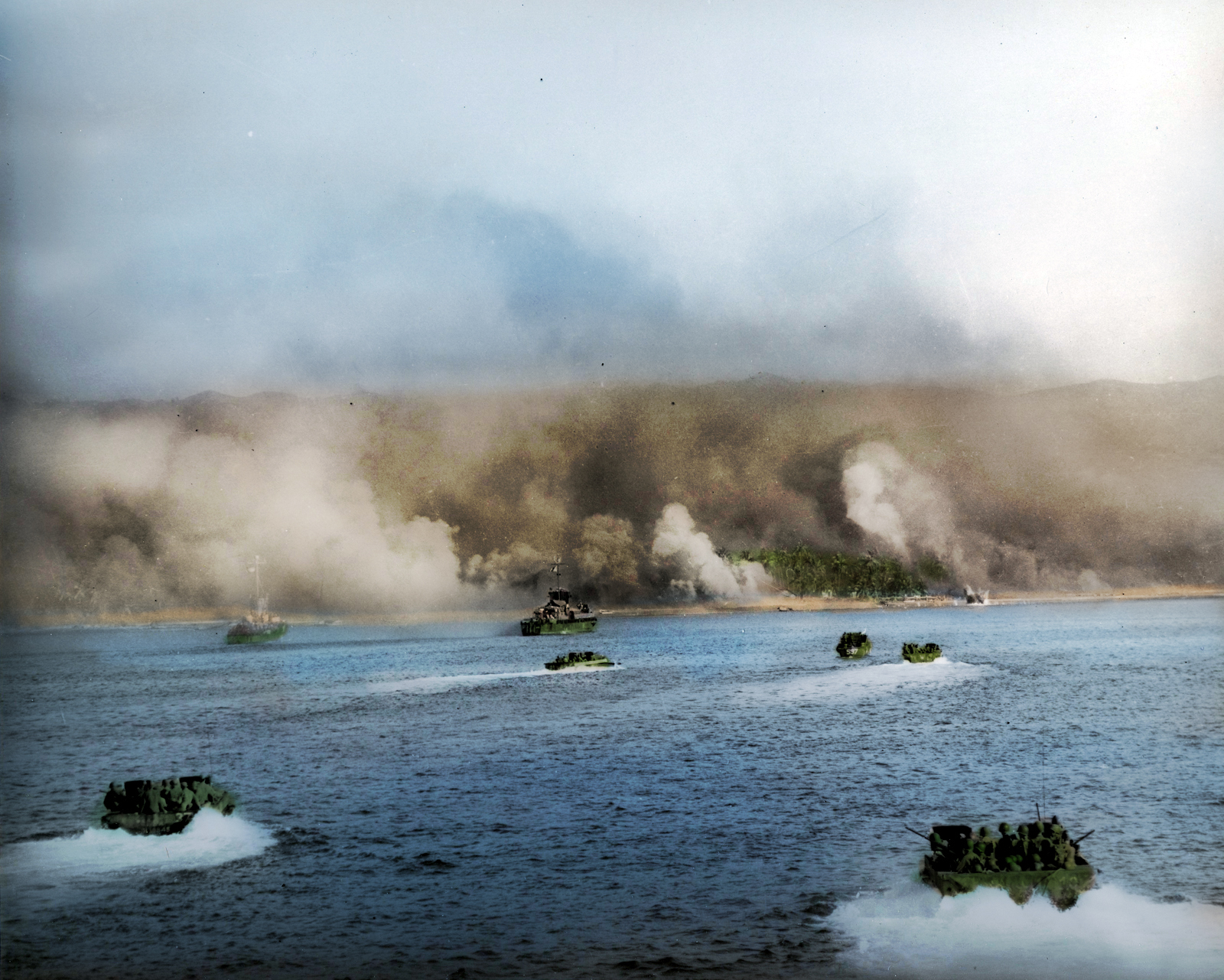
Under Operation Victor II, The 132nd and 182nd Infantry regiments of the Americal Division that landed at Talisay point just south of Cebu City on March 26th, 1945 pushed inland and in two days had secured the city, then by the third day had secured neighboring Mactan island. They encountered sporadic resistance in the form of snipers and small organized pockets of resistance on the outskirts of the City. The light resistance came as a surprise to American forces expecting dug in Japanese troops to defend the city, but instead they left their pre-planned defenses consisting of dug outs and pillboxes to fall back further into the heights that shadowed the City. The Americal division which so far only suffered light casualties from mines or booby traps now faced the daunting task of war in the mountain tops and ridges, war on the hills, and war in the tunnels ahead; for Japanese troops under Major General Takeo Manjome did not have any intention of holding the city in the end, but to wait in the bare mountains.

General William H. Arnold would set up his headquarters in the Cebu Normal School building. Prior to the push into the mountains that would lead to some of the heaviest casualties of the Liberation yet, There was an undeniable need to capture the vital airfield at Lahug. The airfield at Lahug had been a pre war military-civilian installation that once hosted members of the Philippine Air Force launched in 1938. It was an essential requirement that the airfield be captured as combat casualties, supplies and other army needs could be efficiently air lifted rather than brought in with ships. Until such time that it was captured only scant makeshift airfields allowed planes to land in Cebu like those in Asturias and Tuburan. The one in Tuburan in particular being one of the most active during the liberation with many pilots coming to relax along with chat with the girls who often hung out there, however the Tuburan airfield was too far from the city to be a viable option. At some point even Osmeña Boulevard was used as an airstrip with planes landing. The 2nd and 3rd Battalion of the 182nd were given the assignment to dislodge any remaining defenders and capture the field.

Minefields along with other obstacles were present on the way to Lahug, but these were quickly surmounted. The battalions assigned to the capture of the airfield approached at 7:30 a.m in the morning while another battalion of the 182nd regiment moved towards the hills to engage entrenched enemy positions that were busy harassing them the day before into the evening. Cebuano guerrillas met up with troops as they advanced serving both as active combat personnel and guides to the local area; they previously surveyed the area warning American troops of the minefields. Not long after arriving at the outskirts of the airfield did American forces encounter their first taste of stalwart enemy resistance.


The Battle of Gochan hill continued – lit up with fire from lines of defense with mortars together with waves of small arms fire. It was evident that there was no lack of preparation on the part of the defenders with Major General Takeo Manjome had ordered the construction of numerous pillboxes in anticipation of the liberation. Although there were no Japanese troops on the airfield itself, the 2nd and 3rd battalions were bracketed by mortars nonetheless. Sherman tanks and M7 Priest self propelled artillery relieved those who had been pinned down by the gunfire. With a combination of air, naval and land power the Japanese on the hills were, if not silenced, at least forced to stand down for a moment in the face of overwhelming firepower. There are conflicting dates as to when the field was fully secured, but by March 30th, the situation was under control.

The Lahug airfield was finally secured and now the attention of the liberating forces together with guerrilla forces turned to the looming mountains and hills. Gochan hill is located on the rising foot of Babag ridge; it served as an ammunition dump and strongpoint for the Japanese who had fortified it. Tunnels, pillboxes and other positions were set up all over the hill with one of these tunnels containing a stash of explosive ammunitions that posed a great risk that had to be eliminated. Thus was called, the Battle of Gochan Hill. To the Americal, the hill was designated hill 31 for easier identification on maps. On the morning of March 29 the 182nd attacked with Lt. Col. John Watt at its head would begin one of the deadliest battles of the liberation. American howitzers began firing at the hill to soften it up for the upcoming assault at the open horse race track of Hippodromo.
but during the afternoon forward elements discovered that Hill 30 and Go Chan Hill, close together a mile north of Cebu City, were infested with Japanese. The 182d Infantry seized Hill 30 after a sharp fight on 28 March and on the next morning launched an attack to clear Go Chan Hill, half a mile to the east.
-Hyperwar
Persistent fire reduced the hill somewhat, but regardless Japanese defenses were still firing madly into the approaching 182nd lines. The gunfire poured down the slopes of the hill successfully impeding the advance to the chagrin of the commander. The fighting continued for hours until suddenly an explosion rocked one of the approaches to the hill turning the entire battle area into a smoky mess. The previously mentioned ammunition was in actually, a cleverly placed trap for when a good number of American soldiers were above it detonated. The smoke and debris cleared soon after to reveal the bodies of the men of Company A.

lying dead on the ground in addition to a further 30 that were wounded from the explosion; after this moment, the company was dissolved with the survivors distributed among other companies. This was one of the highest casualties suffered in a single day by the 182nd Infantry. The entire 182nd retreated from the hill by the evening to tend to those that were wounded. On the next day and the day after that, realizing that the Japanese had no intention of retreating to defensive positions deeper into the mountains, the 182nd employed the help of Sherman tanks in addition to M7 Priest self propelled artillery in conjunction with Anti aircraft cannons that turned their shells from the sky to the mountains that further pummeled the hill until the end of the day. By dusk on the third day, the battle of Gochan Hill.
At the end of this brutal battle it was found that the Japanese had a total of 85 hardened fighting positions consisting of everything from simple foxholes all the way to fortified pillboxes. Two hundred Japanese are found in the general vicinity of the hill with many more remaining bodies remaining unidentified. American casualties in total of 20 American soldiers dead with 30 wounded. Soon after, another strong point by the name of “Bolo Ridge” was taken with similarly high casualty rates.
“There is no indication that the enemy is short of ammunition, and he is well-equipped with light and heavy machine guns.”
-General Eichelberger, 1945
With the Battle of Gochan hill coming to a close, the doors to the peaks of Babag Ridge were passable, but the Japanese already had a plan in place to, if not totally halt the advance, inflict as many casualties as possible before retreating. The following is the plan that was prepared for the defense of Cebu by Rear Admiral Harada then received by Lieutenant General Fukue.

1. The greatest effort will be made to secure the highest mountain position and the naval positions.
2. Withdrawal from these positions is tentatively scheduled for about 20 April. Rations for one month must be preserved for consumption following the withdrawal.
3. Movement from the present positions will be to the northeast via Liloan to northern Cebu.
4. Forces making the withdrawal will reassemble in the sector north of the Lugo-Tabuelan road.
The next big challenge for the liberating forces was one of the tallest ridges that overlooked the city; one so tall that it commanded a near 360 degree view at its summit. A position so strategically sound that even attempting to take it was to be a daunting task. It was Babag, the mountain whose highest point soared to 442 meters above sea level, where the tunnels ran from peak to peak and where bunkers could cut down any unlucky man who strayed into their firing arcs. To take it would have meant that there would no longer be a high position from which the Japanese could fire artillery from to decimate American forces below or even worse, shell the city. Plans were made and the troops were told, they had to advance.

The days following the Battle of Gochan hill capture were filled with more intense fighting to take other high points and hills, this was until the 11th of April when a concerted effort to take the highest point in the area, Babag, was initiated. The 164th Regimental combat team would be the main force that would drive out the Japanese, it was fresh as it was being held in reserve. In addition, the 182nd, 132nd, were present for the attack on Babag. The battle began with another barrage from Naval forces consisting of several destroyers off the coast. The 182nd, 132nd and 164th regiments pushed forward to flank the Japanese who put up the same kind of stiff resistance previously encountered at Gochan and other hills. Heavy fighting ensued, though slow, the troops were moving forward to higher and higher positions knocking out enemy positions along the way. By the end of the day, Babag ridge was already within reach of American forces. The Battle of Gochan hill was wrapping up and coming to a close.


Finally on the night of April 12th, the American forces launched a surprise bayonet attack on Babag ridge to great success. At 11:55 p.m the advance halted to regroup upon news that there were reinforcements on the way to help them push the Japanese out once and for all. Napalm and incendiary bombs were dropped in support of the American troops which burned out most of the resistance hidden inside tunnels on the bare mountain top. At the end of the day of April 13, 1945, Babag was free. However, unbeknownst to many at the time, a terrible event had occurred on the slopes of Babag ridge; a tragedy that has large gone unnoticed, but that will be a story for another time. Today, older residents still remember the network of Tunnels at Guadalupe and Nivel heights, however at one point there were bunkers in Banawa that led into tunnels, but these were demolished some time in the 2000s.
Sources: Mojares, R. B. (2015b). The war in Cebu.
Sources: Segura, M. F. (2018). Tabunan: The Untold Exploits of the Famed Cebu Guerillas in World War II.
Sources: Report of the commanding general of the eighth army on Cebu operations
Sources: http://www.182ndinfantry.org/tag/lahug-airfield/
Sources:https://history.army.mil/books/wwii/MacArthur%20Reports/MacArthur%20V2%20P2/ch16.htm#p546
Sources:https://www.ibiblio.org/hyperwar/USA/USA-P-Triumph/USA-P-Triumph-31.html
Sources: https://apps.dtic.mil/sti/pdfs/ADA637915.pdf
Sources: https://codenames.info/operation/victor-p-ii/
Sources: https://catalog.archives.gov/

Great post. I was checking constantly this blog and I am inspired!
Very helpful info particularly the remaining section 🙂 I care for such information much.
I was looking for this certain information for a
long time. Thank you and best of luck.