
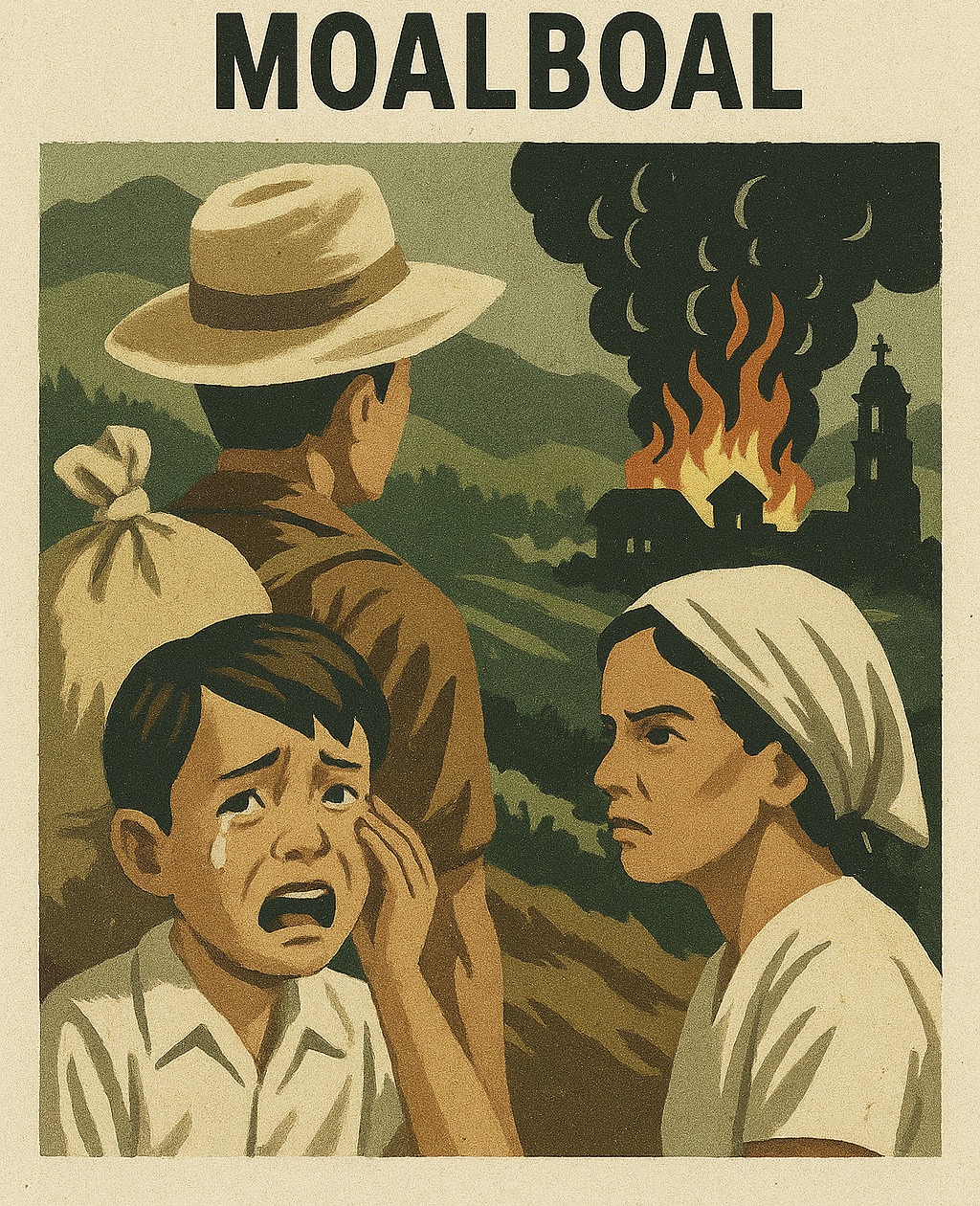
This is a story from the town of Moalboal, Cebu, World War 2 in Cebu.During the Japanese occupation of Cebu from 1942 to 1945, the province became a stronghold of guerrilla resistance. The Japanese Burning of Moalboal was a cruel moment in the chapters of World War 2 in Cebu. After the fall of Cebu City in 1942, many local leaders and civilians joined Colonel James Cushing’s guerrilla forces, which steadily grew in strength. By 1943, Japanese commanders considered Cebu a major problem and in January 1944 deployed the 173rd Independent Infantry Battalion under Lieutenant Colonel Seiichi Onishi, a unit tasked with suppressing guerrillas. Onishi’s men gained notoriety for harsh reprisals, executions, and village burnings—tactics that intimidated some but fueled resentment and strengthened support for the resistance.

By late 1944, guerrillas had consolidated control over much of southern Cebu. It was in this context that one of the most significant clashes occurred: the Battle of Tomonoy in Moalboal. On August 13, 1944, guerrillas ambushed a Japanese detachment in Tomonoy, inflicting heavy casualties and even forcing some troops to surrender. This rare guerrilla victory embarrassed the Japanese and emboldened the local resistance. |UCS|
The day before this battle, however, Moalboal suffered devastating punishment. On August 12, 1944, Japanese troops burned the town, destroying 172 houses and reducing nearly the entire settlement to ashes. Only the stone church of the San Juan Nepomuceno Church, built in the nineteenth century, the convent, and a schoolhouse survived. Local histories emphasize that no ancestral houses remained after the war, as the Japanese razed them all in retaliation. |UnknownCebu| The burning was clearly intended to punish Moalboal for its suspected support of guerrillas and to terrorize residents into withdrawing aid. Yet instead of breaking morale, the destruction deepened hostility and further aligned civilians with the resistance.

The identity of the Japanese unit that carried out the burning remains uncertain. Given the timing, and considering that Onishi’s battalion had arrived in Cebu earlier in 1944 and was notorious for reprisals, it is possible that his troops were directly involved. However, no surviving records explicitly confirm this, leaving historians cautious about attribution. |UnknownCebu| What is clear is that the act followed the established pattern of Japanese counterinsurgency: retaliatory destruction aimed at both punishment and scorched-earth denial of resources to the guerrillas.
In the larger war, the burning of Moalboal was soon overshadowed by the Allied advance. By September 1944, American carrier planes were striking Japanese positions, and by March 1945 U.S. troops landed in Cebu to support guerrillas who had already liberated much of the south. For Moalboal, however, the memory of 172 homes lost in August 1944 remained a lasting scar, remembered as both a tragedy and a testament to its role in resistance.
|UnknownCebu|
Sources:
Mojares, Resil B. The War in Cebu. Cebu: USC Publishing House, 2015.
Segura, Manuel F. Tabunan: The Untold Exploits of the Famed Cebu Guerrillas in World War II. Cebu: Ramon Aboitiz Foundation Incorporated, 2018.
Alburo, Erlinda Kintanar. “Out of Tabunan, On to Liberation.” National Historical Commission of the Philippines. Posted April 3, 2025. Accessed August 29, 2025. https://nhcp.gov.ph/arti…/out-of-tabunan-on-to-liberation/
Consulate-General of Japan in Cebu. “Letter from Cebu (No. 6) ‘Relations between Japan and Cebu – During WW-II and After.’” Letter from Cebu, August 10, 2022. Accessed August 29, 2025. https://www.cebu.ph.emb-japan.go.jp/…/11_000001_00447.html
Bersales, Jobers R. “The Remains of War.” Cebu Daily News (Opinion), December 6, 2017, 10:23 PM. Accessed August 29, 2025. https://cebudailynews.inquirer.net/156637/the-remains-of-war
de la Cerna, Madrileña. “A Notable Remembrance.” Cebu Daily News (Opinion), December 13, 2015. Accessed August 29, 2025. https://cebudailynews.inquirer.net/…/a-notable-remembrance
Wikipedia. Moalboal. Last modified July 26, 2025. Accessed August 29, 2025. https://en.wikipedia.org/wiki/Moalboal#cite_note-12
Bersales, Jobers Reynes. Facebook post in Old Memories of Cebu (Facebook group), December 13, 2024. Accessed August 29, 2025. https://www.facebook.com/…/155…/posts/4012749769048974/4


