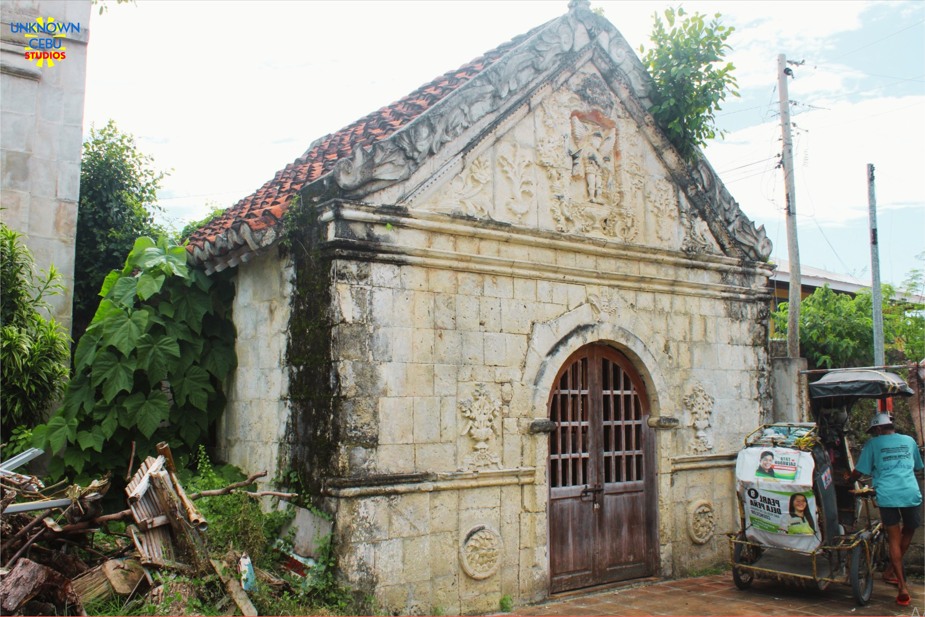
The town of Argao, Cebu, is the home of many heritage sites, one of which is the Capilla Mortuario and the Puerta Marina. Argao’s Spanish period history was partly influenced by Moro pirate raids from Mindanao. Located within the confines of the once walled-in church complex, the two structures share an equally interesting and storied past. In the case of the Capilla Mortuario, it was used as the mortuary chapel for those who were having their wakes post-mortem. Among heritage buildings in Cebu, it is one of the most richly decorated and well-preserved as some sections still have the original pigments applied in the colors of blue, green, and red. Inside, a bas relief of the holy cross was raised from the stone. It was built in the 18th century. The façade of the chapel is ornately carved with bas reliefs with the center being a Saint Michael rescuing what appears to be a child from the gaping mouth of a demon. Other reliefs have imagery of a cross, skulls, and other baroque motifs.


The Puerta Marina is a massive structure that serves as the main gateway to the sea. It was possibly built before the Capilla Mortuario. Moro pirate raids necessitated the building of a defensive wall surrounding the church complex of Argao, making it one of the fortified town Pueblos of Cebu similar to those of Dalaguete, Boljoon, and Oslob further south of Argao. The Puerta Marina served as one of three or four gates that could be closed during a pirate attack. The Pirates did not have the ability to breach walls that were so thick and strong. The structure — one of the best preserved in the area — still retains its original purpose. This structure alongside a “Baluarte” that faced the sea, greeted visitors who came by the way of sea-routes.


|UnknownCebuStudios|


