The Sugar industry of Talisay is rich in History and is an integral part of the history of Talisay, Cebu, it was one of the driving factors in the growth of the town. The families of Cabusas, Garces, Lastimosa ,Kong, Belleza and many others became prominent and wealthy. The summarized history of the Sugar Industry is presented in my other article but i will do a recap here. When Governor Basco Y. Vargas opened the Philippines to trade in 1834, Philippine products were in demand worldwide, so cash crop production meaning the production of crops specifically for money and not food. During the 1860s Talisay was a hub for business in the form of agriculture because it was the gateway to southern-Cebu. Talisay depending from which direction you are coming from is either the first or last gateway to and from the City. By the By the 1880s Talisay had a Intusan or Sugar Mill located in Uldog Today, this was destroyed during the Philippine Revolution. In 1922 the new American Colonizers built a new sugar mill, this was in modern day Barangay Mohon and this is what i will be talking about today. This is the only ruin of the Mohon Sugar Central Mill.

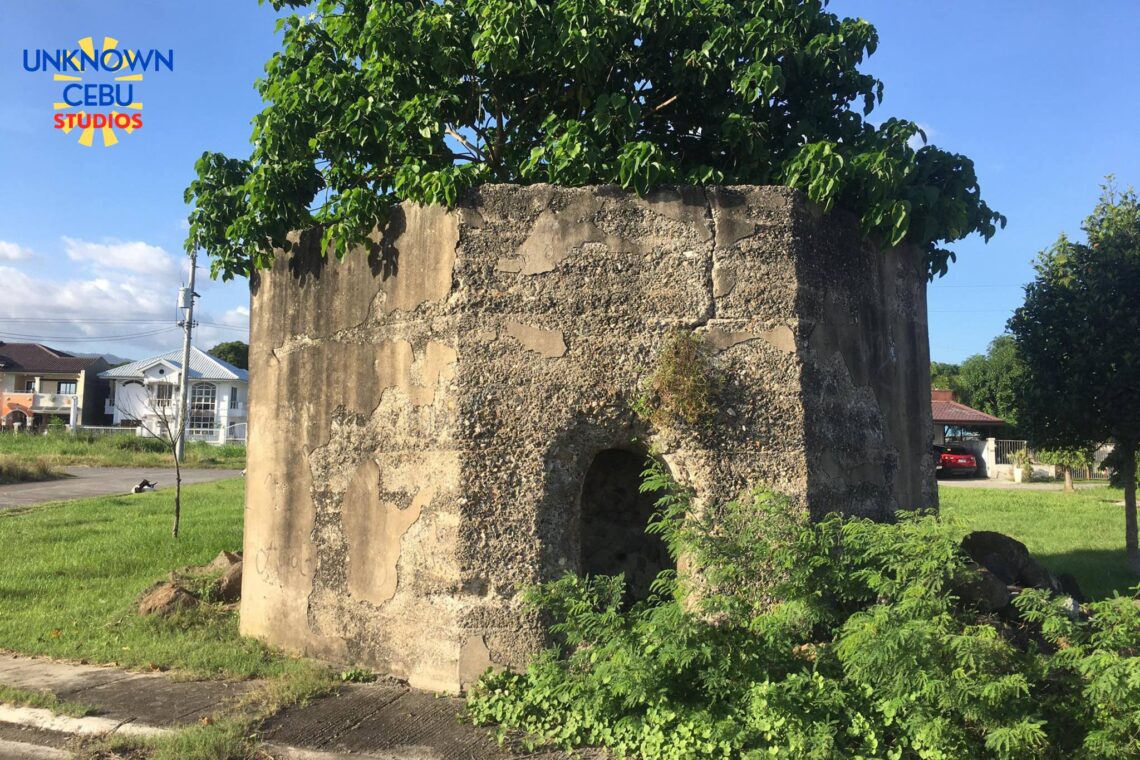
This is one of the Chimneys of the Mohon Central Sugar Mill. The history of this mill goes back to 1921 when large US companies wanted to invest money into the Philippines, part of this was the development of agriculture. The most abundant products coming from the Philippines was the Abaca plant used to make Abaca fiber which would then be made into all sorts of products. The Sugar industry was still strong in the Visayas region though and so when the Philippine Sugar Corporation wanted a Sugar mill in southern Cebu they chose Talisay specifically Barangay Mohon as their Location. The land on which the Sugar Mill once stood is owned by the Cabusas Family who are also owners of a ancestral house in Nonoc,Talisay. The land was once friar land belonging to the Talisay-Minglanillia estate owned by the Augustinian friars. When the land was sold and subdivided into smaller more manageable lots this lot was purchased by the Cabusas-Bas family because they were already a Wealthy and prominent Talisaynon family during the time. In the year 1922 the land was leased to the Philippine Sugar Corporation. The size of the lot is enormous the lot has a size of 5.1 Hectares, and 3 Hectares were occupied by the Corporation. The Mohon Sugar mill was one of the largest in Cebu during peak season it would employ over 300 people, but after would employ around 70.

The Chimney that remains is inside the private subdivision of Pueblo San Ricardo in Mohon. The current owner of the Subdivision where the chimney stands is still the Cabusas family. Mr. Carl Cabusas who manages the subdivision explained to me that after World War 2 his father and grandfather found the ruins of the Sugar Mill that had been burned in 1928. The concrete foundations and some low walls remained, interestingly some treasure hunters came and asked for permission to dig on the site, his father denied them, but the treasure hunters still tried to dig up the property for treasure leaving holes everywhere, a relatively unknown part of the history of Talisay City, Cebu. After World War 2 the train tracks that were once used by trains picking up Sugar from the mill going north were dismantled by the father and grandfather of Carl Cabusas. There is evidence that the Chimney was converted into a large water tank because the area where the person would put in the Sugar was blocked with a small iron tube sticking out with water dripping.

The Chimney is one of 4 that were built in 1922, this is the only remaining one. The foundations of another chimney still exist but are only a concrete circle in the ground. The chimney itself is made of thick American Period concrete probably from the Taiheiyo Cement company which was already operating in Naga during this time. The chimney is octagonal in shape and is very large, about 15 feet in diameter with walls 3 feet thick. Mr. Carl Cabusas said that when the subdivision was built the area was raised by putting a massive amount of dirt and sand. This included the area where the original location of the mill was burying it, fortunately the Concrete chimney survived and was supposed to be marked as a historical site. The local government unit came to visit the structure during the Heritage mapping programs of Cebu governor Gwen Garcia in 2009, they inspected the structure and would not allow the Cabusas Family to build the subdivision if the Chimney was going to be destroyed. Fortunately a compromise was reached, the subdivision would be built but the chimney would be preserved.

Today the Chimney is preserved inside the subdivision, unrecognized but protected. For the coming generations this will be one of the reminders of the history of not only barangay Mohon or Talisay, But for the entire Cebu province. I thank Mr. Carl Cabusas the current manager of the subdivision for allowing us to interview him and for letting us see the ruins.