The Warrior Priest of Boljoon, Fray Julian Bermejo Horabuena, O.S.A can very well be hailed as one of the defenders of Cebu against the unrelenting onslaught of Moro pirates from their territories in Mindanao. It is his contribution to the defense of the south in the form of the organization of the “Barangayan” system of warfare in which fleets of ships called Barangay would set out to intercept enemy fleets, in addition to that, was his great contribution in the organization of the Baluarte/Bantayan sa Hari system of watchtowers that were once stalwart sentinels that watched the seas for incoming invaders on the horizon. His successes at the Battle of Sumilon (1813) and further battles against pirate armadas would earn him commendation from the governor general and the loyalty of his constituent parishioners. The fleets that would meet the enemy on the seas were successful; Baluarte were constructed all along the coast as sentinels and Boljoon was one of the most fortified towns on the entirety of the island, yet even with all of this work done over the span of some two decades, work was still required. This is the story of two of the watchtowers on the southern tip of Cebu.

Boljoon was not the only town that was filled with souls ripe for the taking by Moro pirates, no, there were others spaced out among the plains that dotted the limestone cliffs and tall gorges that characterize southern Cebu’s landscape. Present day Alcoy, Oslob, and most relevant to us today, Santander were all distant visitas that took hours, possibly even days to travel to making any trip a risky venture in it of itself. The situation that Fray Julian Bermejo was faced with in the first years of his arrival in Boljoon in the year 1802; a lack of protection for the distant towns that were still under his jurisdiction. The town of Boljoon had already been invaded in 1783 leading to its near annihilation. Other towns in the general vicinity had also suffered greatly under the thumb of the Moro raiders leading to the construction of many Watchtowers otherwise called Baluarte or Bantayan sa Hari meaning “Watchtower of the King” in reference to the fealty of the country to the king of Spain. The guards assigned to each tower would be given code names like “San Fabian” or “Santo Tomas” for easier identification. It is commonly accepted that forced labor was used to build these watchtowers, however some may have been built upon the free volition of the townspeople under direction of men like Fray Julian Bermejo. Two of these watchtowers were built in the town of Santander, then called Tañon, to serve as the guardians of the town in addition to being the first light that would warn other towers up the chain as to the position of incoming enemies that used the present day Tañon strait and Cebu strait as main thoroughfares for their slave expeditions.

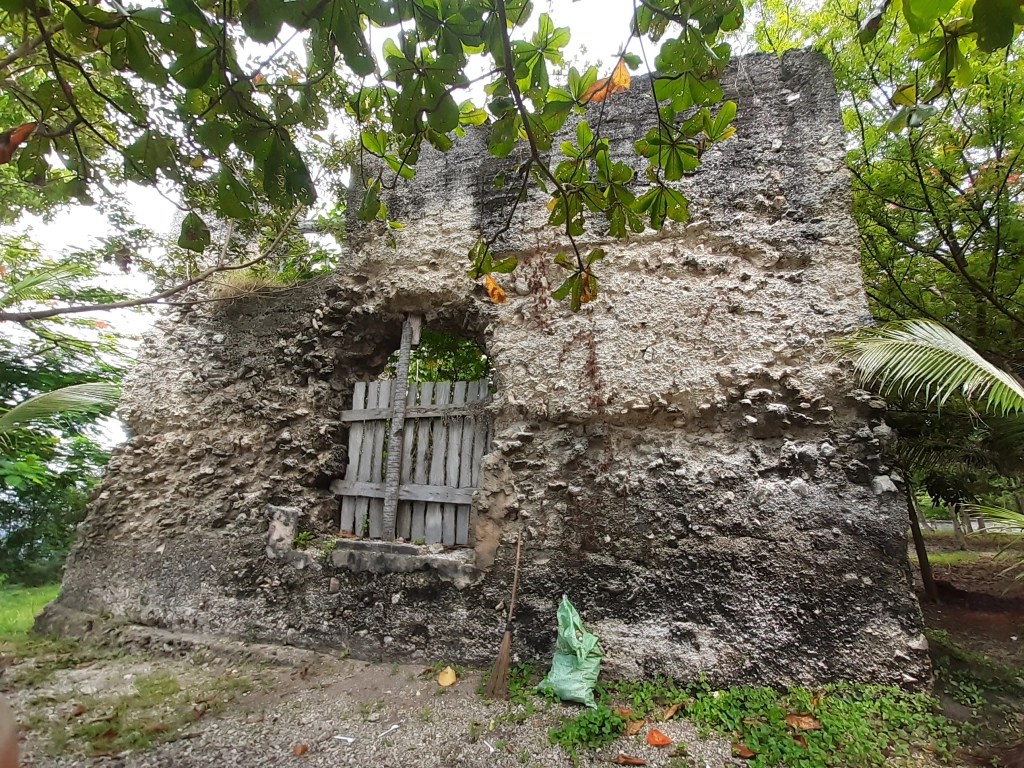
The first of the watchtowers is located right behind the church of present day Santander. Another ruin exists of what was once the bell tower, but this structure is completely separated in both make and construction as compared to the watchtower in the back. It is constructed out of Mamposteria which is a stone and mortar construction brought by the Spanish after their successful colonization of sites like Mexico followed by Guam then the Philippines. Stone masons would crush rock of any type, in this case coral stone, to be used in construction in conjunction with mortar made of certain leaves, shells, and many other materials. When mixed together, the coral stone and mortar mixture may be used to build watchtowers such as this one. There is a good chance that the guards assigned to this watchtower were given the code name “San Gabriel Archangel” as that is the present day patron saint of the Parish of Santander; in fact Santander is the only town in Cebu that has San Gabriel Archangel as it’s patron. The watchtower itself is in a deteriorated state with individual coral stone slowly being eroded into finer coral rubble that can be chipped away by the elements, however much of the original finish is still present on the upper levels. It is unknown when exactly this watchtower was constructed.


In the year 1808, Fray Julian Bermejo finally extended the line of Baluarte to the very tip of Cebu in the south which is present day Barangay Liloan, Santander. Liloan was not only a strategic position being at the tip of Cebu, but it was also a defensive choice as the nearby “Lilo” or the raging interlocking current would sweep away most invaders that dared to come close to the tower. This watchtower guarding the intersection of the Cebu and Tañon straits was one of the most important ones in the whole system of defense. Once an enemy was spotted coming from any direction. A series of flags would communicate between the watchtower at Santander and the one in Oslob then the one at Oslob would raise the signal further and further north until it reached the end of the line even further up north thus ensuring that towns and villages were properly informed as to the movement of the enemy. This certain watchtower still stands today as it has for over 200 years overlooking the rocky cliffs, white sands and turquoise waters characteristic of the area. A bronze cannon along with falconets were attached as armaments to this Baluarte making it one of the most well armed ones in the system. Fray Julian Bermejo personally visited the watchtower sites to ensure that the each one could be viewed from the others.


The structure itself is one of the best preserved in the entire province. It is still complete with the whole quadrilateral structure still having its original Paletada (Paletada being the final finish of lime applied to protect the structure) all around. There is some signs of erosion on the stones, but over all it is a passable reflection of what a functioning watchtower looked like back in the days of Fray Julian Bermejo, save of course for the giant parasitic tree which has made the lonely tower its home. This watchtower was specifically mentioned in a report by Fr. Bermejo to the order that on October 3, 1825 a fleet of 27 moro Panco (Panco being the term used for Moro ships by Fr. Bermejo) were spotted and raided the town of Cocot. The damage caused by this event is not recorded in history. What is important is that this extant piece of history is still within grasp today, literally and figuratively. One can still feel the stones that previous generations’ builders have piled high, the smell of the ocean that they smelled so long ago and even the same magnificent undisturbed view of Dumaguete across the strait. The men guarding these watchtowers are no longer with us, in addition, due to the defeat of the Moros in the battle of Balanguingui in 1848 against Spanish forces under Governor General Narciso Clavería y Zaldúa, pirate raids would dwindle and so would the usage of the watchtowers.
This is the end of the line for this post. Please consider reading the other parts of the Warrior Priest Fray Julian Bermejo’s Saga or expand your knowledge by reading other posts on the website!
Sources: Bolhoon: A cultural sketch, Paul Gerschwiler
Sources:El «Padre Capitán» Julián Bermejo y la defensa contra la piratería mora
en Cebú, ROBERTO BLANCO ANDRÉS


One comment on “The Saga of Fray Julian Bermejo Part 3: The Watchtower at Tañon Santander”