“She has been with me nearly my entire life. She has never been too bothersome. My home — the one you are standing in; this one — is as much my home as it is her home. In times of trouble, she is my solace; in that way, she has protected me for the longest time, even in the twilight years of my life.”
-Nanay Loling, 93 Y.O
Antique images of saints and religious figures are a definitive part of Philippine culture that has been with the Filipino people since the earliest days of the Spanish colonial period. Even before the Spanish period, one can find, in many forms, wooden figures carved as Gods of various patronages; therefore, Filipinos having a distinct sort of affinity towards the religious arts are not a recent development, but something developed over many centuries. Centuries pass by, and the people change, although some aspects of life never falter. One aspect of life binding together the rich heritage of Catholicism brought by the Spanish and the pre-colonial love of carving is Holy Week — the most significant week of the year for some.

During the Spanish colonial period, many families, affluent or not, were designated as the “Camarerro/a” of a particular image of the parish for what may be called the grandest tradition observed during Holy Week in the Philippines — the pasos. The Pasos is a procession of a series of images depicting the last day of Jesus Christ. Religious images — those of saints, Roman soldiers, the Virgin Mary, and Jesus Christ — are processed around a designated route along the streets of a town. The images, in most cases at least, are carried not by the people, but by drawn carts called “Carroza.” A wide variety of Carroza styles exist ranging from simple rectangular carts elevated by mish-mashed wheels, and covered by cloth all the way to towering behemoths several times the height of the people lugging them and decorated with all sorts of finery; beaten-metal works, embroidered skirts, alongside carved scenery of flowers, hills, and choirs of angels descending from meter high candlesticks.
Our story today focuses on one such image; one in the care of a darling old lady who prefers to be referred to as “Señora” for most intents and purposes. This is the story of an image that has survived a World War, being lost twice, notwithstanding a whole litany of miracles attributed to it; borne across centuries as a symbol of faith, despite the realities of a world most inconducive to resilience. We focus today on one such story: The Mother who speaks in the night.
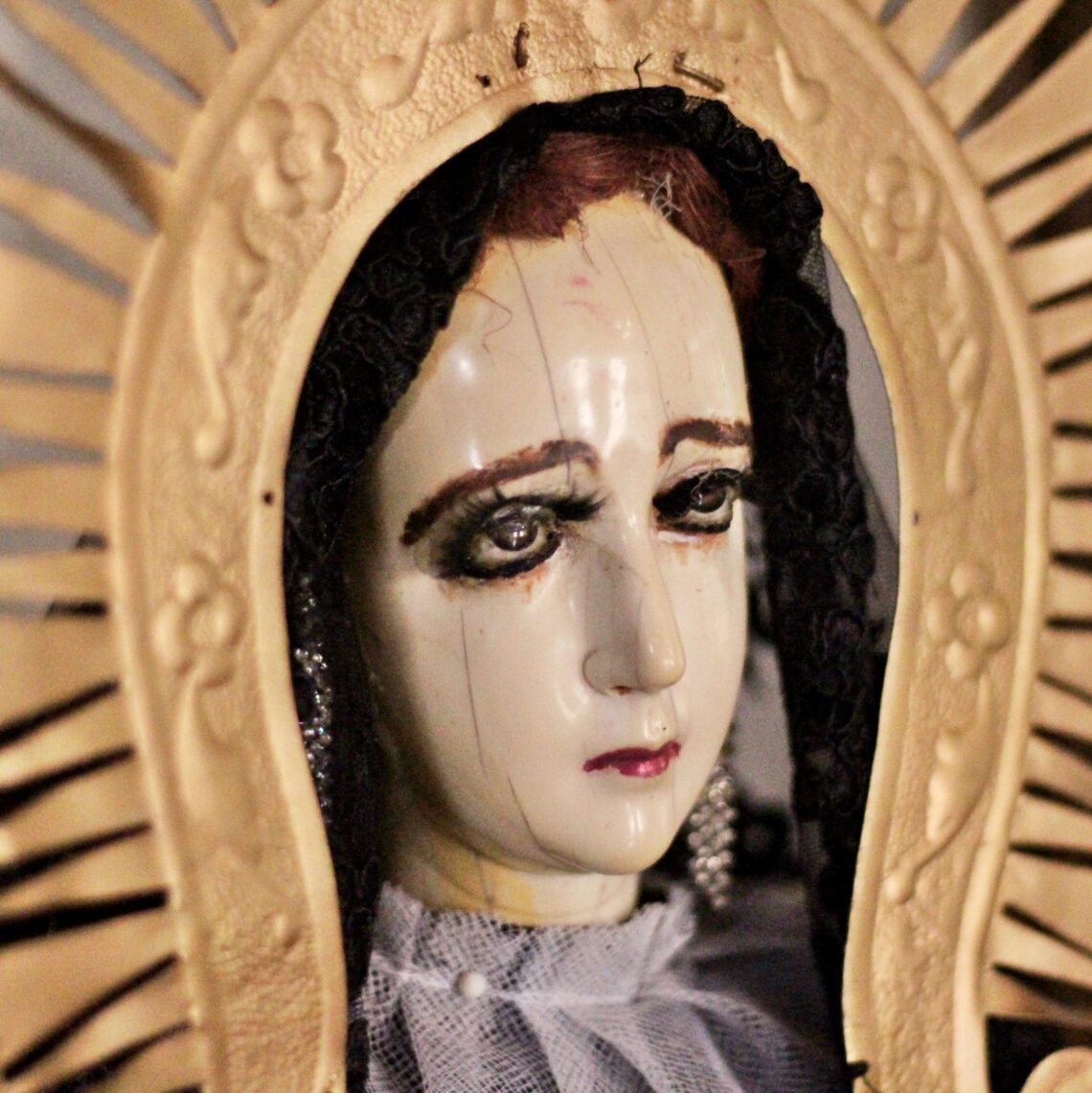
Her silky ivory skin tells of over a century of existence in its dark finicky lines streaming down from above all the way down to her neck; her eyes look upward as if in muted contempt and humble acceptance of the fact that she has become the Mother of Sorrows. On most occasions, the Mother of Sorrows sits idly by, watching the world pass; however, Holy Week necessitates her revelation once more.


Nanay Loling has been the “Camerrera” for this image of the “Mater Dolorosa” or “Mother of Sorrows” in english for nearly her entire life. She first encountered the image when she saw it being dressed up for Holy Week — 87 years ago in the year 1937, when Nanay Loling was only 6 years old — by her grand aunt, one Sofia Lazo; one described as one of the richest and most generous in Talisay during her day. Nanay Loling’s experience with the image throughout her childhood consisted of yearly visits to her aunts house. When she came of age, a duty of hers was to prepare the vestments of the Mater Dolorosa together with her mother and other members of the family.
My grandaunt was the caretaker of the image assigned by none other than the parish priest at the time, Fr. Crispin Davis. He was a tall man, who, in his need, asked of my grandaunt to become the caretaker of the Mater Dolorosa as it was sitting inside the convent without anyone tending to it.
-Nanay Loling
The years passed without much to say until World War 2. Nang Loling’s parents learned of the incoming Japanese invasion and chose to evacuate several kilometers south to some hills where the family had some property. Among the preparations for evacuation was the packing of the valuable religious images. She was disappointed and worried to have to leave for a new location. What comes next is the personal testimony of Nanay Loling translated into english from her native language of Cebuano.
I never paid much attention to the prospect of war, for war was to us, merely a childhood game we played to keep ourselves occupied. My parents, oh!, they were very afraid it appeared since it only felt like a few days from a town meeting at the municipal hall that we were rushing to pack our valuables to evacuate or “Bakwit.”
For some reason that I can no longer recall, the Mater Dolorosa was with us in our home. I distinctly remember it’s body made of darkened wood and pristine head looking down on me as I heard my father shoveled loads of money somewhere. I was then told to disassemble the ensemble. In my haste to perform this action, I mistakenly placed the hands into a sack made of buri which explains why the hands of the Dolorosa today is no longer ivory, but what you see now is a mere replacement; however, the ivory head is still the original I saw many many years ago in my childhood.
The family evacuated in 1942 to the town of San Fernando, Cebu, in order to escape the perceived wrath of the Japanese whom were then described as savages who skewered babies and executed heinous crimes against humanity. The young girl of back then had no idea of the reality of war; no ideas of admonished human agony; no ideas of the hells of Nanking or Manila. It was during the young Nanay Loling’s stay that she would experience first hand, the types of miracles only heard of in legends and tales. It was late in the evening she says when the ivory head seemed to call to her in the darkness…
It was late at night on a Friday. We (the children) were supposed to be asleep by this time, but some ethereal presence had been bothering me for a while. We left days before on a large truck bound for the hills of Cabatbatan, San Fernando, though the whole time until that night, I was always bothered. Somehow, my conscience kept calling me to check the small jewelry box where the head of the Dolorosa was wrapped in rags.
I remember seeing the moon outside the windows before opening the jewelry box; it was then when I discovered the Dolorosa standing before me in her full anguish and glory. Of course, my fear first took me over, being only a young child, though it was only moments later when I felt deeply attracted to her as one would be with their own mother.Both of us talked for hours on end about topics as mundane as the rustling of the leaves all the way to questions like “Why did love drive your son, Jesus, to die?” She answered, she always answered. At time time, in my childish naivety, I treated the event as a mere conversation with someone who I had known for many years.
The moment came to pass just like many others. The Mother of Sorrows left her to sleep beside a bed of rattan. Stories like this still continue to fill the mind of Nanay Loling nearly a century later; one may find it hard to believe — at times, the unbelievable may hold a kernel of truth.


Today, the image is still in the home of Nanay Loling, enjoying the peace of a home no longer disturbed by a World War. After the war, the family taking care of the image purchased an elegant Carroza on which the image would be placed on during Holy week processions. Just recently, the family commissioned an artist to produce some new vestments for the antique image; Nanay Loling was able to enjoy the brand new vestments to replace the ones she had purchased herself many years ago, marking the first time the vestments were changed in six decades.
Nanay Loling being the Camarerra of the image for many years surprises none who know her very well, for one of the reasons why she was chosen to inherit the image is her actual name: “Dolores”
Even in my old age, even as time moves on leaving me behind, I believe that that night was not a dream. If I am to pass away this instant, I believe she will be there again — not as a bearer of sorrow — but a bearer of the eternal promise of God, paradise.”
-Nanay Loling, 93 Y.o
Photographs were provided by: Mtqs Photography.


Amazing, spectacular, splendid. In the words of the Alumni “INCREIBLE”