
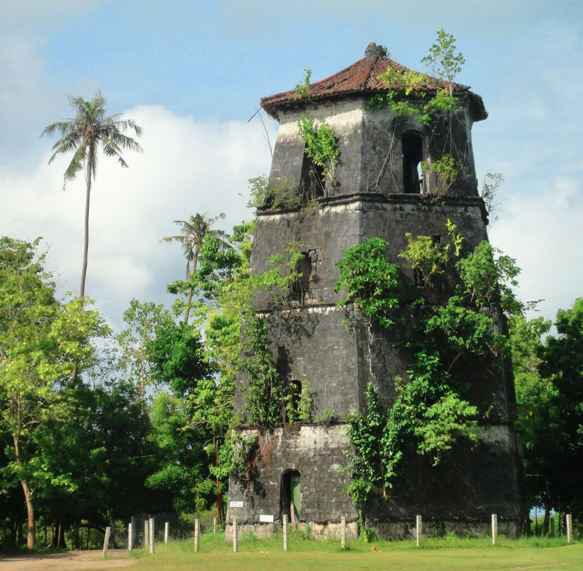
Okay, let’s be real. When you think of Panglao, you think beaches—Alona, Dumaluan, all that white sand goodness. You think diving, sun, and perhaps the chocolate hills if you venture off-island. But just a stone’s throw from the new international airport, tucked next to the centuries-old church, there’s a structure that utterly redefines what a historical site can be. Forget the usual quaint church ruins you find across the Visayas; Panglao is home to a military-ecclesiastical masterpiece, the Panglao Watchtower, and for anyone who loves deep history, architecture, and untold colonial tales, it’s a history nerd’s goldmine. This sentinel, towering over its surroundings, is not merely a landmark, but a profound material testament to centuries of conflict and human ingenuity on this exposed maritime frontier.


Perched strategically on Panglao Island, this isn’t just a picturesque ruin; it was the Central Visayas’s geopolitical tripwire. Its location was a grim necessity, born from centuries of intense conflict during the devastating Moro Wars, with documented raids plaguing the central islands as early as the late 16th century. Picture this: the entire Spanish coastal defense, the baluarte network, depended on massive, permanent structures like this one to maintain continuous surveillance and spot organized raiding parties sweeping across the vital maritime corridor of the Bohol Sea. Its mere existence, a towering edifice of local coral stone masonry completed in the late colonial period of 1851, screams long-term, high-stakes commitment by the Augustinian Recollects who managed the parish. The construction secured Visayan maritime lanes and coastal Christian communities, or reducciónes, demonstrating a substantial commitment of colonial resources to secure this exposed region. The fact that the Philippine government has formally declared it a National Cultural Treasure (NCT) alongside the adjacent San Agustin Parish Church tells you everything you need to know about its exceptional cultural and military importance under the National Cultural Heritage Act (RA 10066).

The Watchtower Prior to Restoration 2012 (Note the Tisa Roof)

The Watchtower Prior to Restoration 2012 (Note the Tisa Roof)

The Watchtower Prior to Restoration 2003 (Note the Tisa Roof)
What truly sets the Panglao Watchtower apart in the Spanish colonial defense typology is its astonishing architecture, representing a true culmination of 19th-century defense design. First, its height: at an imposing five stories, it’s officially the tallest Spanish-era watchtower surviving in the country. This wasn’t for bragging rights; it was a pure, critical tactical move, guaranteeing the earliest possible sighting of a hostile sail across the expansive Bohol Sea, thereby facilitating the timely transmission of warning signals to interconnected defense posts like Dauis. Second, its shape: while most other Spanish towers are simple square, rectangular, or cylindrical forms—like the Dauis tower—Panglao’s is built on a rare hexagonal plan. Architectural historians even noted its distinctive “curved silhouette”, achieved by subtly varying the angle of inclination of each straight section. The size and thickness of the walls also make this watchtower unique. There are other watchtowers in Bohol and beyond, but none of this magnitude except for the Gran Baluarte in Boljoon and a watchtower in Ilocos. This non-standard, six-sided geometry was a highly sophisticated engineering choice, providing superior structural stability against the strong rotational forces imposed by the high winds and typhoons prevalent in the Central Visayas. This deliberate complexity and maximum verticality make it the pinnacle, or the most advanced architectural evolution, of Bohol’s colonial defense design.


The tower’s integrated function perfectly embodies the colonial system known as the Patronato Real, which seamlessly fused military necessity with religious administration. It wasn’t just the primary military lookout; it was simultaneously the community belfry for the adjacent San Agustin Church. This physical and functional integration ensured the tower was the operational center of both spiritual and civil life. The bells, which regulated the daily schedule of the community by signaling times for mass and prayer, instantly became the auditory component of the colonial defense system. The moment a pirate vessel was sighted from the top observation level, the rapid ringing of the massive bells instantly shifted the structure’s purpose from peaceful religious observance to military mobilization, alarming the local inhabitants. Simultaneously, long-range communication was achieved using visual signals—smoke during the day or lanterns/fire at night—to relay the warning to neighboring watchtowers, creating a coordinated defensive line and ensuring its perpetual strategic importance.

Standing at the base today, you are confronted by the severe scars of time. The tower’s coral stone masonry has endured centuries of corrosive maritime corrosion and, critically, sustained damage during the 2013 Magnitude 7.2 Bohol Earthquake, which caused significant outward bulging in the walls. The heroic Phase I stabilization in 2012–2013, supported by a US Embassy grant, was a crucial intervention. It successfully sealed the roof and consolidated the exterior walls, a focused strategy that likely mitigated catastrophic structural failure when the structure was subjected to extreme seismic forces just months later. But here’s the problem, and it’s a massive one: The entire internal timber structure—the five levels of wooden floors and the winding staircase—is completely gone due to sustained water ingress from a collapsed roof prior to Phase I. This is a functional and structural catastrophe.

This structural deficit is why Phase II internal restoration is the absolute, non-negotiable priority for the National Museum of the Philippines. We can’t actually go up the five stories because the staircase is missing, which means the tower is currently structurally compromised and functionally incomplete. Rebuilding those five levels of wooden floors is essential for two reasons: structurally, the new floors will reintroduce the critical horizontal diaphragms needed to brace the historic coral masonry walls against lateral forces, enhancing the tower’s long-term seismic resilience. Functionally, the restoration of the staircase is the only pathway to responsible adaptive reuse, allowing the public to safely ascend and experience the historical vantage point of the country’s tallest watchtower. The plan requires meticulous adherence to conservation best practices, using scientific material characterization and traditional joinery techniques. Securing and dedicating the requested PHP 40 million budget for this intricate internal reconstruction is the key to finally realizing the full potential of this phenomenal National Cultural Treasure and integrating it into the Panglao Tourism Masterplan. Until Phase II is complete, this phenomenal piece of history is literally grounded.
Sources:
Bohol Provincial Government, Provincial Planning and Development Office (PPDO). “Tourism Master Plan.” Accessed November 18, 2025. https://ppdo.bohol.gov.ph/plan-reports/development-plans/tourism-master-plan/.
U.S. Embassy in the Philippines. “Restoration of Panglao Watchtower, Panglao Island, Bohol.” December 14, 2017. https://ph.usembassy.gov/restoration-panglao-watchtower-panglao-island-bohol/.
Cubilian, Lizbeth Ann. “Bohol tourism officials step up efforts to restore Spanish-era heritage sites.” Philippine News Agency, December 14, 2017. https://www.pna.gov.ph/articles/1018889.
U.S. Embassy in Laos. “The U.S. Ambassador’s Fund for Cultural Preservation (AFCP).” Accessed November 18, 2025. https://la.usembassy.gov/the-u-s-ambassadors-fund-for-cultural-preservation-afcp/.
Gariando, Vangie B. “Cultural agencies come together for Bohol, Visayas.” Lifestyle.Inquirer.net, May 19, 2014. https://lifestyle.inquirer.net/174298/cultural-agencies-come-together-for-bohol-visayas/.
“Highlights of Panglao Island Tourism Masterplan by Palafox (Part 4 of 4).” Scribd. November 20, 2012. https://www.scribd.com/document/113920526/Highlights-of-Panglao-Island-Tourism-Masterplan-by-Palafox-Part-4-of-4.
Guide to the Philippines. “Panglao Watchtower.” Guide to the Philippines. Accessed November 18, 2025. https://guidetothephilippines.ph/destinations-and-attractions/panglao-watchtower.
Delightful.ph. “Heritage-inspired Bellemar Lifestyle Center set to boost tourism in Panglao.” Accessed November 18, 2025. https://www.delightful.ph/blog/category/4/travel-news/post/1004/heritage-inspired-bellemar-lifestyle-center-set-to-boost-tourism-in-panglao.
ForeverVacation. “Panglao Watchtower.” ForeverVacation. Accessed November 18, 2025. https://forevervacation.com/bohol/panglao-watchtower.
“Panglao, Bohol.” Wikipedia. Last modified October 29, 2023. https://en.wikipedia.org/wiki/Panglao,_Bohol.
“Raid of Visayas.” Wikipedia. Last modified June 18, 2023. https://en.wikipedia.org/wiki/Raid_of_Visayas.
muog. “Panglao Tower • Panglao, Panglao Island, Bohol.” muog (blog), January 31, 2008. https://muog.wordpress.com/2008/01/31/panglao-tower-%E2%80%A2-panglao-panglao-island-bohol/.
Gallivantrix. “Panglao Watchtower (Tag).” Accessed November 18, 2025. https://gallivantrix.com/tag/panglao-watchtower/.
Spl1. Scribd. May 26, 2023. https://www.scribd.com/document/646773418/spl1.
u/Raptor_Lover. “Panglao Watchtower in Bohol: One of the few, if not the only…” Reddit, r/Philippines. December 23, 2020. https://www.reddit.com/r/Philippines/comments/kjdh7h/panglao_watchtower_in_bohol_one-of-the-few-if-not/.


