
Alcoy, in Southern Cebu, is globally renowned for its crystalline waters and white sands, particularly at Tingko Beach. However, the town’s true historical depth is anchored by the Alcoy Convent, or Kumbento. Constructed and completed in 1890, this structure holds singular architectural significance as the only remaining Spanish-era edifice in the municipality, making it a tangible link to the late Spanish colonial administration. During that era, the convent served a dual role—not merely as the residence of the parish priest, but as a crucial administrative and social hub, potentially hosting early educational classes. This multifunctional purpose elevates the building to the status of an Ancestral House, designed to project the stability and permanence of the ruling institutions, characteristic of Spanish Colonial architecture even at the close of the 19th century.

Crucially, a distinction must be made between the structure’s 1890 foundation and the artistic layer within. The highly preserved ceiling paintings on the second floor of the Kumbento are a beautiful historical palimpsest. Their elaborate embellishment program is attributed to the American Colonial era, specifically the period between 1920 and 1957. This time saw the flourish of the Cebuano kisame (ceiling painting) Renaissance, driven by new economic capacity and a local ideological urge to artistically enhance religious and associated domestic spaces. Thus, the Alcoy paintings are a dynamic 20th-century artistic program overlaid upon a 19th-century architectural canvas, signifying a period of post-revolutionary modernization and aesthetic renewal within the town’s spiritual leadership.


To properly understand the Alcoy ceiling, it must be situated within the dominant artistic context of Southeastern Cebu. The kisame tradition was spearheaded by celebrated masters such as Canuto Avila, Raymundo Rubi Francia, and Mariano Villareal, who produced comprehensive religious programs across the region. While the Alcoy Convent paintings currently lack a definitive attribution to one of these major ateliers, their existence confirms the pervasive influence of the movement. The execution style aligns closely with the “folk native” aesthetic—works produced by provincial painters who, while perhaps lacking formal academic training from Manila, cleverly adapted Classical and Renaissance techniques. This style exhibits a certain flatness and focuses on immediate decorative impact, contrasting with the deep illusionistic trompe l’oeil seen in larger church naves.

The artist’s choices were also dictated by the material constraints of the domestic setting. Unlike the grand plaster vaults of major parish churches, the Alcoy Convent ceiling utilizes simple, diagonal wooden planks, or tablillas. This material is prone to movement and warping, which structurally discourages vast, seamless murals. Consequently, the artist was compelled to adopt a modular and planar decorative system, dividing the ceiling into discrete, repeated vignettes and geometric compartments. This practical constraint forced a reliance on strong framing and clear organizational geometry, which skillfully united disparate iconographic elements into a tapestry-like overall design—a hallmark of the ingenuity demonstrated by provincial kisame artists.

The unique value of the Alcoy Convent ceiling lies in its pronounced thematic divergence from its religious contemporaries. While the church ceilings were visual catechisms focused on allegories and saints, the convent art prioritizes a secular, domestic motif: the overflowing fruit basket, or Natura Morta. These elaborate still-life arrangements, featuring tropical fruits like citrus and gourds, universally symbolize earthly abundance, prosperity, and hospitality. This iconography was highly appropriate for a residence and reception area, aligning the decorative scheme with the structure’s function and reflecting local bounty.
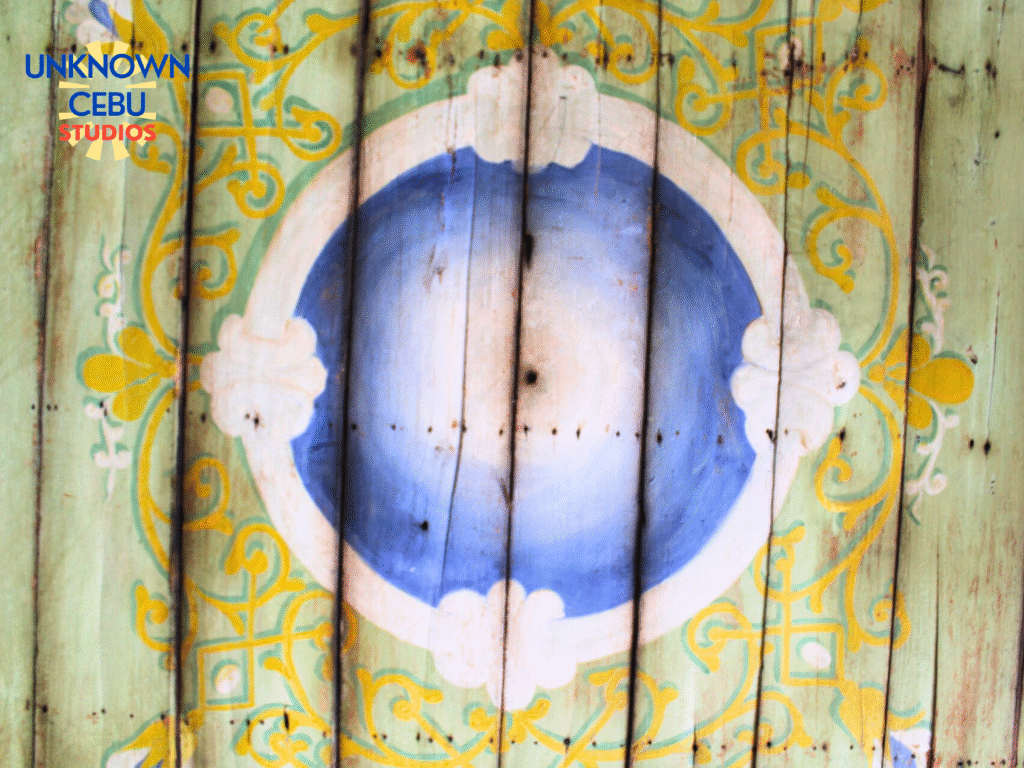


The artistic synthesis is further underscored by specific visual details. The artist frequently frames the tropical fruit arrangements with European decorative devices, such as flowing blue ribbons and the white and blue scallop shell (concha) motif. The concha is a classic element from European Baroque and Rococo architectural embellishment. Its inclusion demonstrates that even when celebrating local content (tropical produce), the Alcoy artist was relying upon established imported pattern schemes and design books to formalize the vernacular subject matter. This fusion of European form with localized content is definitive of colonial artistic synthesis in the Visayas.
Given its thematic uniqueness and stylistic importance, the Alcoy Convent ceiling is an irreplaceable piece of Visayan art history. Its preservation is noteworthy, particularly since many colonial ceilings in metropolitan Cebu were lost to renovations or shifting tastes. As with all heritage properties, the wooden substrate remains vulnerable to moisture and infestation. Therefore, immediate heritage management should focus on high-resolution documentation and archival research within local parish and municipal records. Identifying the precise patron, the exact year of the painting program, and the artist’s identity would definitively place this valuable domestic artwork within the timeline of the regional kisame tradition, ensuring its long-term recognition.
Sources: Alcoy Municipal Government. “History of Alcoy Cebu.” PDF document. Accessed November 17, 2025. https://alcoycebu.gov.ph/wp-content/uploads/2023/10/HISTORY-OF-ALCOY-CEBU.pdf.
Aldor, Joel. “Lessons from Project Kisame.” Medium. Accessed November 17, 2025. https://medium.com/@joelaldor/lessons-from-project-kisame-4fa99f756c6f.
Cañete, Reuben Ramas. “Ceiling Murals in Southeastern Cebu Churches.” Asian Studies: Journal of Critical Perspectives on Asia 49, no. 1 (2013). Accessed November 17, 2025. https://asj.upd.edu.ph/mediabox/archive/ASJ-49-1-2013/Ceiling%20Murals%20in%20Southeastern%20Cebu%20Churches%20-%20Reuben%20Ramas%20Caete.pdf.
“Cebuano Painting.” Cebu Daily News. Accessed November 17, 2025. https://cebudailynews.inquirer.net/41329/cebuano-painting.
“HISTORY.” Scribd. Accessed November 17, 2025. https://www.scribd.com/document/678136555/HISTORY.
“Historical Sites.” Unknown Cebu. Accessed November 17, 2025. https://unknowncebu.com/category/historical-sites/page/6/.
Wikipedia. “Spanish Colonial architecture.” Accessed November 17, 2025. https://en.wikipedia.org/wiki/Spanish_Colonial_architecture.


