


A warrior who along with his people defended the land they collectively called home; a teacher of arts, medicine and literature who instead of making others adjust to his prospectively foreign needs instead adjusting to his people. A priest whose veracity together with his ferocity in teaching the faith gave rise to a legacy that still has its impacts to this day. A visionary who saw the problems of his time and corrected them to not only serve his personal interests, but also the interests of the people and cradle of faith he was sheltering. He is not well known among the places where he once tread and the descendants people he once protected, however through perspiring work we may trace the steps of this elusive man of character so peculiar among his peers. There is something special about a man who had his passion in building fortresses, training people for war and winning decisive victories against a previously insurmountable enemy. His name is one that sparks memories to those who recognize him. This man, so important, yet so arguably shrouded in mystery is Fray Julian Bermejo Horabuena, O.S.A ; the warrior priest of Cebu.

We enter Fray Julian Bermejo Horabuena was born in the year 1777 at Pardillo, Ciudad Real, Spain otherwise known as Villanueva de San Carlos. Not much is known about his early life as is the case with many figures in history. It is quite possible that he was able to acquire the standard education of the time, but by 1793 at the age of 16 he boarded a vessel at Cadiz bound for the colony half the world away from España shortly after his profession to being a part of the Augustinian order at Colegio de Valladolid, sources are unclear on this one. From this point and time he went to study in San Agustin in the walled citadel city of Intramuros, Manila. It was here when he begot the inspiration to go Cebu to the south of Manila in furtherance of his studies and to also study the Visayan language in the path of earlier efforts to understand and decode the language which at this time was still under study. It was in Cebu where he completed his studies and became an ordained priest of the Augustinian order. His studies in Cebu and taking up of the language suggests that he was starting to form a passion. Here his decades long journey in Cebu would finally begin to take shape.

Fray Julian Bermejo’s first assignment as a newly ordained priest was the far flung southern town of Boljoon or Bolhoon. Here he would be known by many names such as “El Padre Capitan” by the Cebuanos. His arrival was a great improvement to the situation in terms of the number of priests on the island as when he first arrived there were a grand total of five Augustinian parish priests. There was a short two period window of time where he served as the priest of Argao’s Saint Michael the Archangel church from 1802 to 1804, but otherwise he spent his first years in Cebu at Boljoon. In Boljoon he first had the duty of rebuilding what was destroyed during the 1782. He found the town had still largely remained damaged from the raid of the bane of organized communities in and around not only Cebu, but the entirety of the Visayas region, pirates.
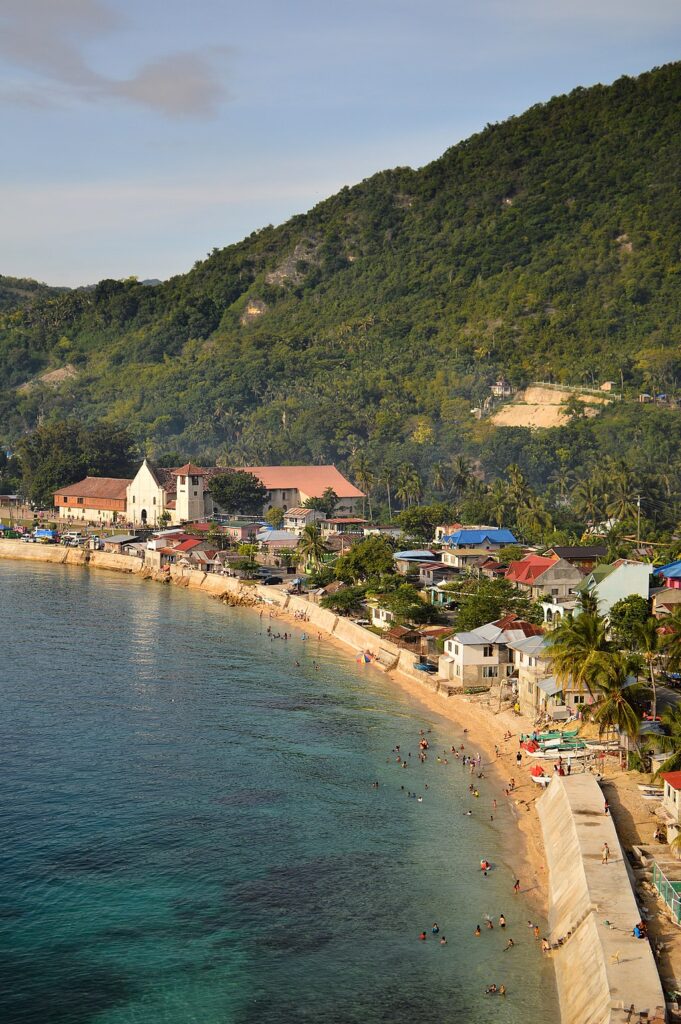
The Town of Boljoon.
Moro pirates originating from the Sulu and Celebes seas would pour into the seas and straits of Negros, Cebu and Leyte to raid, pillage along with setting any large community to the torch, all the while slaughtering inhabitants together with taking any fit people with them back from whence they came; to cart off as slaves to be sold to the giant labor hungry colonies of the East indies. The first of these recorded raids linked to the Spanish colonization of the Philippines happened in June 1578. From this point they realized the great economic potential of the new tightly packed, set in stone settlements instituted by the Spanish crown in and around the Visayas. The pirates sailed with near absolute impunity for around two centuries carrying out their activities which forced many a town to relocate or simply disappear completely from the map. These pirates would use many different kinds of ships during their heyday, most prevalent of which is the native ‘Lanong’ which is galley. Galleys are long ships usually with sails, though much of the power can also supplied using manual labor in the form of slaves acting as oarsmen pushing oars through the water. Fr. Bermejo referred to these ships as ‘Panco’
He devised this system during his multiple assignements as the parish priest of Boljoon; the first lasted from 1802-1808; the next being 1829-1830; 1839-1842 and then 1846-1848. He was there when the old church of Nueva Caceres, then called Ivisan, was completed in 1828. He was also a pivotal figure when Oslob to the south was declared a parish in 1848.
These pirates were a formidable force that until the early to mid 19th century were left vast unchecked power over Mindanao and the Visayas. Many communities lived in fear that the pirates would strike them next as in the case of Bantayan in 1600 and 1636, both times the church was sacked with many Bantayanons taken as slaves leading to a depopulation of the island. Fray Julian Bermejo’s assigned parish of Boljoon was not exempt from these devastating pirate raids as it too was raided in the year 1782.
“Bolhoon was reduced to ashes almost in its totality, with the parish house and church plundered and set on fire, saving only some sacred clothes and the image of the Patrocinio del Santisima Virgen, the titular patroness of the town.”
-Paul Gerschwiler | Bolhoon:A Cultural Sketch
The pirates were an existential threat to the continuing existence of towns and parishes all around the region. At was during these desperate times of the continuous danger of your town of being burned and townspeople taken away as slaves to never be seen again that Fray Julian Bermejo begun to formulate his own plan to check the power of the proverbial ‘Titan of Piracy’.

In years prior to his arrival there had already been scattered efforts to defend the coastline, though it was only through the coordination and cooperation brought on by Fr. Julian Bermejo that a solid plan was developed. This plan was to increasingly fortify the coasts of Cebu and neighboring islands with watchtowers and with that devise a system of communication between them to effectively give advanced warning and information as to the whereabouts of incoming or outgoing pirate fleets. They accomplished this through It can be said that information distribution during this time was a great priority for him. In this regard he rallied the natives who already had the expertise to build stone structures to build them along strategic points along the coastline. In line with this, Fray Julian Bermejo thought out this system to be able to achieve several things which may or may not include the following.
- To ensure effective communication between towns to inform of incoming or outgoing pirate fleets
- To be able to hand some advanced warning for the townspeople to be have the time to evacuate to safer areas
- To serve as last ditch safe refuge for people in the area
Obviously Bermejo was not the first parish priest to arbitrate some type of protection measure. But he was probably among those who dedicated themselves to it with more effort, more time, effectiveness and success
Roberto Blanco Andres: El Padre Capitán Julián Bermejo y la defensa contra la piratería mora
en Cebú (Translated)
Other than the construction of watchtowers, whose alternative terms include the Spanish term Baluarte and the Cebuano term of ‘Bantayan Sa Hari’ or ‘Bantayan’ meaning lookout of the king which denoted the association with the Spanish crown and lookout respectively; is the implementation of a system of training for the native Cebuanos to combat the pirates themselves. In essence Fray Julian Bermejo began teaching and propagating the strategy of having fleets of ships called Barangayanes to intercept enemy Moro pirate fleets en route to destinations to prevent their landfall. The Barangayanes ships would sail out in fleets to attack Moro pirate fleets that were first spotted by the Bantayan Sa Hari along the coast. These Barangayanes fleets were so successful in their skirmishes and outright battles with the Moro fleets that they would chase down the enemy as far as Apo Island to the south and provide adequate deterrence for anyone who dared to raid. The small plucky boats were armed with small falconets. Falconets were one of the main weapons of choice; fundamentally they were smaller cannons developed in the 14th to 15th century that could be used on small vessels to deadly effect.


In Boljoon the so called “El Gran Baluarte” on the southwest corner of the Boljoon Church complex was completed in 1808 according to Paul Gerschwiler in his book “Bolhoon: A Cultural Sketch”. Among other things was the consturction of a thick coral stone wall surrounding the entirety of the complex with gates on each side and a smaller Bantayan sa Hari on the northwest corner. The huge two storey coral stone Baluarte was used to store ammunition and arms should the worst come to pass. On the lower floor was a prison cell. The erection of this Baluarte was a monumental achievement as it is one of the largest in the Philippines, an achievement done under Fr. Julian Bermejo’s direction. In his letters to the governor-general of the Philippines at the time, Don Pascual Enrile, Fr. Bermejo also mentions another watchtower atop a cliff in Boljoon on Ili rock; during his entire assignment in Cebu he was writing letters to those in power detailing the situation, the need for arms and the efficiency of the Barangayanes fleet.

The whole project was so successful to the point that the Deputy inspector of the Royal Office of Artillery had granted Fr. Julian Bermejo the use of two bronze cannons with the caliber of 4” and a supplementary armamental of two 2” caliber. Other than the firepower of large bronze cannons was the additional armament given like 12 rifle along with much of the necessary ammunition needed to fire them. The arms would find themselves at the disposal of the warrior priest who put them into good use. These ‘teeth’ that would bite into the menacing pirates were placed on several strategic locations.

Even as Boljoon was fortifying itself against pirates then found itself protected by several outer and inner fortifications; the same could not be said about the other farther Visita of Boljoon like modern day Santander or Nueva Caceres. These deficiencies in the defense of the south were what Fr. Julian Bermejo spent much of his time fixing.
This was to be the foundation of safety that Fray Julian Bermejo had a large part in playing. Over a period of several years he would further improve upon the fortifications and levels of training. This sets the scene for the next part of his great saga wherein we will see how successful his plans were; including the legacy of all of his efforts today. The next part of this series on the Saga of Fray Julian Bermejo will see his part in the BATTLE OF SUMILON
Sources: Bolhoon: A cultural sketch, Paul Gerschwiler
Sources: Angels in Stone, Pedro G. Galende, OSA
Sources:El «Padre Capitán» Julián Bermejo y la defensa contra la piratería mora
en Cebú, ROBERTO BLANCO ANDRÉS
Sources: https://santoninodecebubasilica.org/chronicles/fray-julian-bermejo-osa-el-padre-capitan-boljoon/

One comment on “The Saga of Fray Julian Bermejo Part 1: An Age of Pirates and Baluartes”